
Last updated September 25, 2026
How to Hire a ADU Contractor in Chino Hills: A Step-by-Step Guide
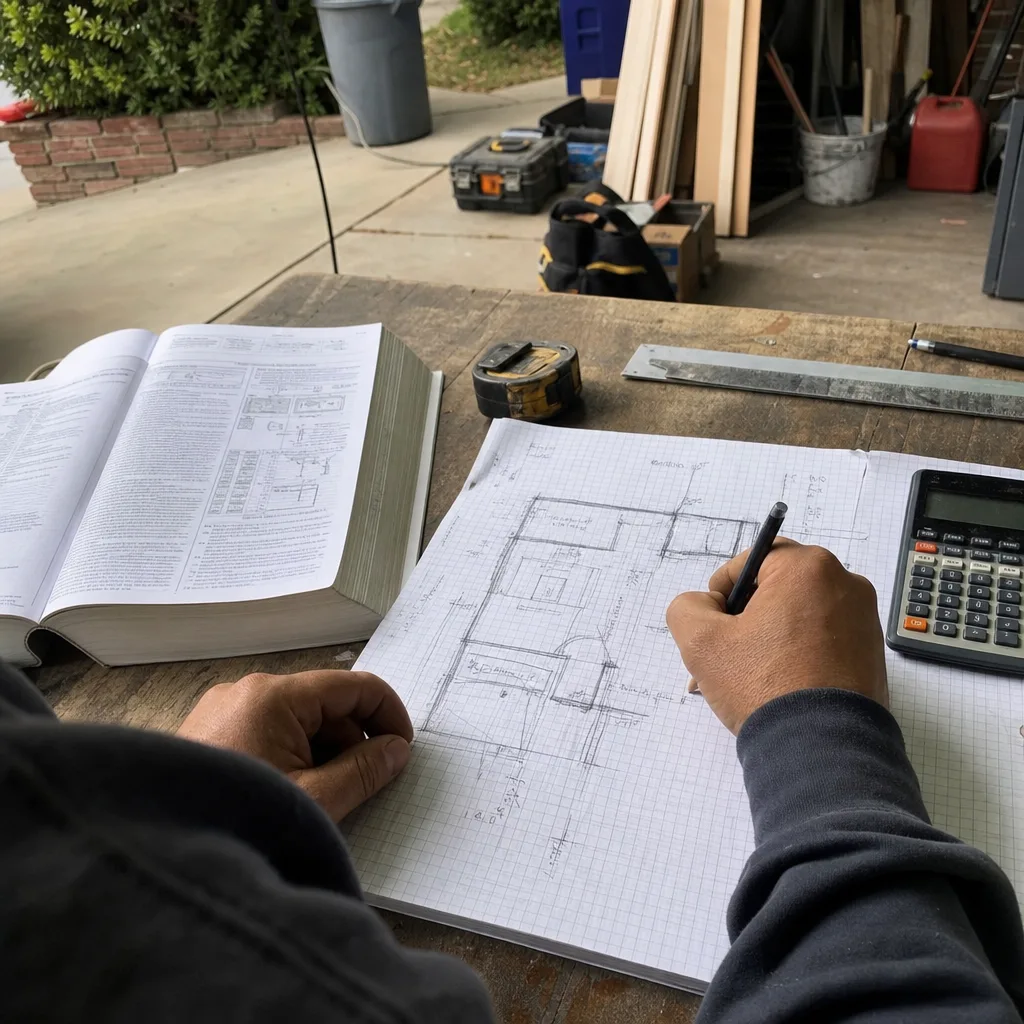
The most common ADU dispute in California isn’t fraud. It’s a legitimate contractor who produced drawings that didn’t match what the builder priced, leaving the homeowner with a $40,000 gap and two parties each pointing at the other. In Chino Hills, where San Bernardino County’s utility districts and the city’s hillside grading requirements add layers most general contractors haven’t navigated, this gap widens fast. This guide identifies the five contract clauses that determine whether your ADU project succeeds before a single footing is poured.
Quick Answer
Hiring an ADU contractor in Chino Hills means verifying a California B-license with CSLB, confirming ADU-specific project history, and signing a contract that defines scope by permit set, locks change-order thresholds, schedules lien releases, assigns permit-pull responsibility, and specifies warranty terms. A design-build contract eliminates the designer-versus-builder blame gap by making one firm accountable for drawings, permits, and construction at a single written price.
Table of Contents
- How to Verify a Contractor’s License and ADU Track Record
- The Five Contract Clauses That Determine ADU Success
- Why Design-Build Contracts Eliminate the Blame Gap
- Interview Questions Specific to Chino Hills
- Red Flags in Proposals Before You Sign
- What ADU Construction Costs in Chino Hills
- Permits and Timeline: Chino Hills Reality
- Common Mistakes to Avoid
- When to Call a Professional
- Frequently Asked Questions
- The Bottom Line
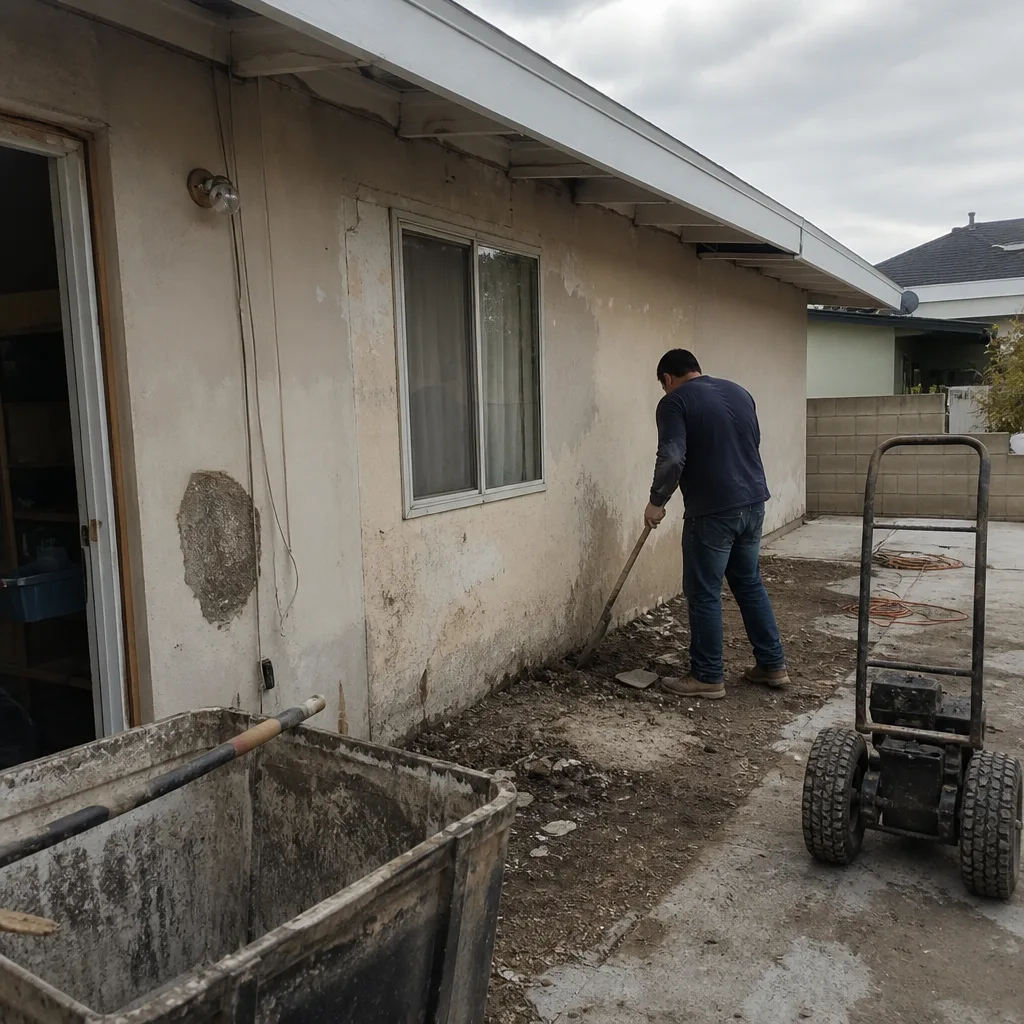 Before
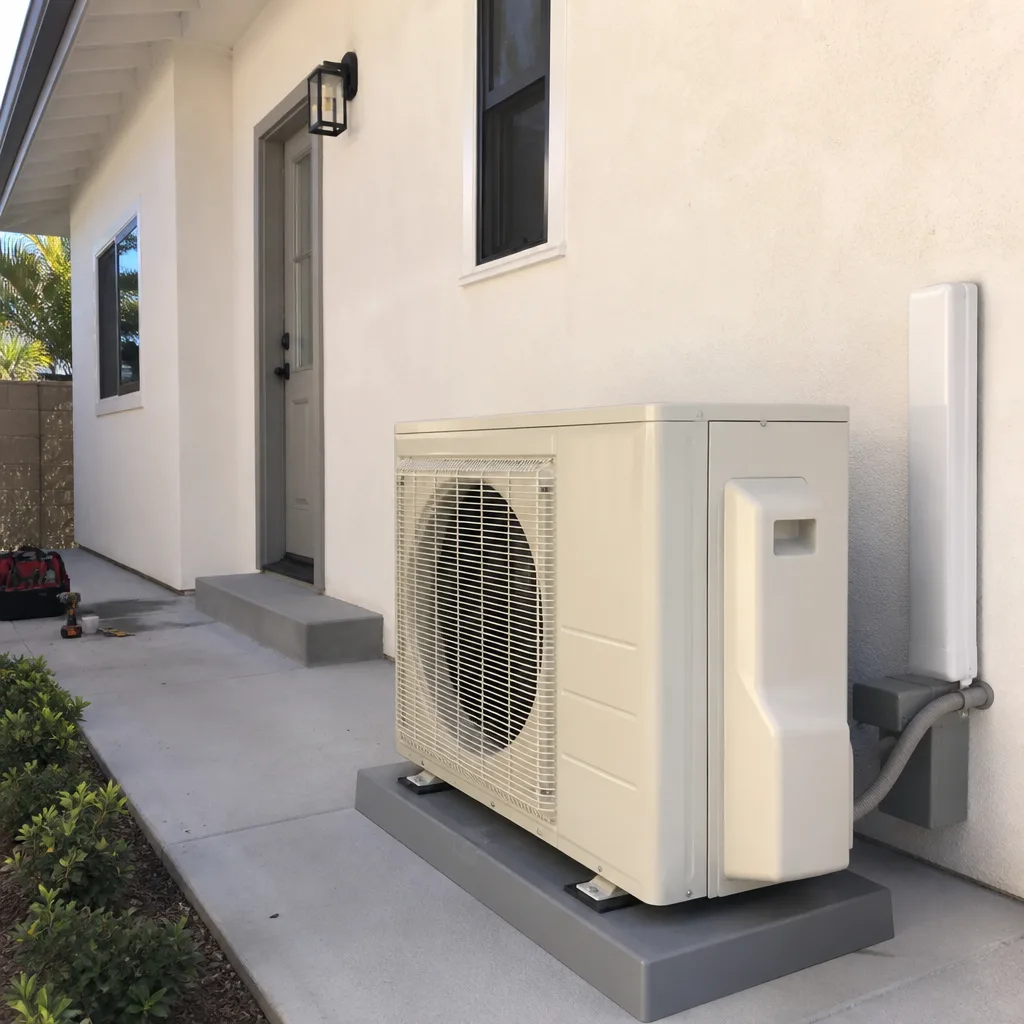 After
AfterHow to Verify a Contractor’s License and ADU Track Record
Every contractor working on your Chino Hills ADU must carry a California B-General Building Contractor license. Verification takes two minutes on cslb.ca.gov, but most homeowners stop at “active license.” They shouldn’t.
Here’s what to check:
- License classification: B-General Building is required for ADUs over 500 square feet or any structural work. A C-36 Plumbing or C-10 Electrical license alone cannot legally serve as the prime contractor for a full ADU project.
- Complaint history: Click “Complaint Disclosure” on the CSLB record. Look specifically for complaints related to “plans not matching construction,” “permit issues,” or “cost overruns.” These patterns predict the designer-builder gap.
- Workers’ compensation: If the contractor has employees (and any ADU project requires a crew), workers’ comp must be active. Exempt status with employees is a red flag.
- License bond: $25,000 minimum. Verify it’s current, not just listed.
- Years licensed: Cross-check against claimed experience. A contractor advertising “15 years in ADUs” with a license issued in 2021 is telling you something.
Ask for three ADU-specific references with addresses. Drive by them. In Chino Hills, look for projects in neighborhoods with similar topography to yours. A contractor who’s built only on flat lots in Ontario may not have encountered the hillside grading and drainage requirements that affect properties north of Grand Avenue or east of Pipeline Avenue.
At Ellery ADU Studio Chino Hills, our license number appears on every page. We pull it up ourselves before the first meeting.
The Five Contract Clauses That Determine ADU Success
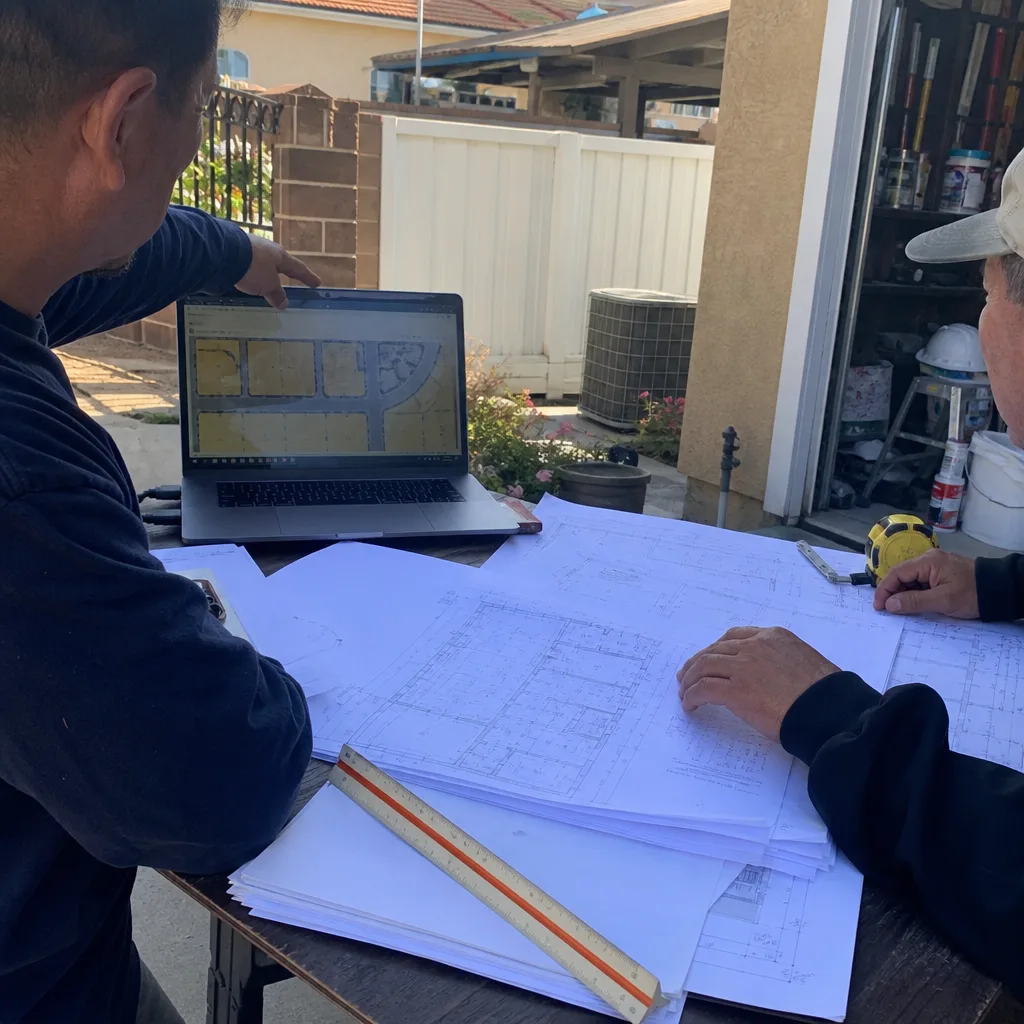
The contract, not the contractor’s personality, determines whether your ADU finishes on budget and on scope. These five clauses matter most:
1. Scope Definition by Permit Set
The contract must reference the specific permit set - the stamped drawings approved by Chino Hills Building & Safety - as the sole definition of scope. Not a narrative description. Not “build ADU per plans.” The actual drawing set, dated, with plan check number.
Why this matters: California law allows contractors to deviate from “plans” if the plans aren’t incorporated by reference. A permit-set reference locks the build to what the city approved. Under ADU Design & Permitting in Chino Hills, we deliver the permit set as the contract’s Exhibit A before construction starts.
2. Change-Order Threshold
Every contract has change orders. The question is who decides when one triggers. Set a dollar threshold - typically $500 or $1,000 - above which the contractor must obtain written approval before proceeding. Below that, they can proceed and bill.
Without this threshold, a contractor can accumulate $400 charges across fifteen items and present a $6,000 surprise. With it, you review each material decision.
3. Lien Release Schedule
California mechanics liens can be filed by anyone who supplied labor or materials, even if you paid the contractor in full. Your contract should require:
- Conditional lien releases from the contractor with each payment
- Unconditional lien releases from all subcontractors and suppliers before final payment
- A 10% retention hold until all releases are collected
In Chino Hills, where material suppliers serve the broader Inland Empire, a subcontractor’s unpaid roofing supplier can lien your property even if you paid the roofer. The release schedule prevents this.
4. Permit-Pull Responsibility
The contract must state who pulls permits, who pays fees, and who schedules inspections. Ambiguity here causes months of delay.
Chino Hills requires building, electrical, plumbing, and mechanical permits for ADUs. If your contractor expects you to pull permits, that’s additional work you may not have budgeted. If they pull permits but you pay fees separately, that’s a cost surprise. Specify.
5. Warranty Term and Documentation
California requires a one-year implied warranty on workmanship. Your contract should exceed this with explicit terms: what components are covered, for how long, and what documentation proves the warranty exists.
Our New Detached ADU in Chino Hills projects include the 365-Day Done Right Promise: if the finished ADU is not built to the permitted drawings, we make it right, in writing, before the project starts. The documentation - photo records at every visit, written scope at signing - becomes the evidence if a claim arises.
Why Design-Build Contracts Eliminate the Blame Gap
The traditional ADU process splits design and construction. An architect or designer produces drawings. A contractor bids from those drawings. When the drawings don’t match field conditions or the contractor’s interpretation differs from the designer’s intent, the homeowner pays to resolve the gap.
We’ve seen this in Chino Hills specifically. A homeowner in Vellano received garage conversion drawings showing a 4-inch slab adequate for residential use. The contractor priced assuming no slab replacement. During demolition, they discovered the existing slab was 2.5 inches with no vapor barrier - insufficient for the conditioned space. Designer said “not in our scope.” Contractor said “not in our bid.” Homeowner paid $8,400.
A design-build contract makes one firm responsible for both. The same entity that specified the slab thickness in the permit set prices its replacement if needed. There’s no gap to fall into.
To verify a design-build firm actually integrates both functions, ask:
- Who stamps the structural drawings? (Must be a California-licensed civil or structural engineer, not the contractor’s “in-house designer.”)
- What happens if the permit set requires revision after plan check comments? (Design-build firms absorb this; split contracts bill separately.)
- Can you show me a completed project’s permit set, final invoice, and photo record? (Evidence of integration, not claims.)
Garage Conversion ADU in Chino Hills projects particularly benefit from design-build integration, since existing conditions - slab depth, roof structure, electrical service - aren’t fully knowable until demolition begins.
Interview Questions Specific to Chino Hills
Generic ADU experience doesn’t translate directly to Chino Hills. The city’s location at the intersection of Los Angeles, Orange, and San Bernardino counties creates specific conditions. Ask these questions:
- “Which San Bernardino County utility districts have you worked in?” Chino Hills properties may fall under Chino Hills Water District, City of Chino Municipal Water, or Golden State Water depending on location. Each has different connection fee structures and capacity availability. A contractor who’s only worked in Rancho Cucamonga may not know Golden State Water’s meter sizing requirements.
- “How do you handle hillside grading for properties north of Grand Avenue?” The northern portion of Chino Hills has significant slope. Grading plans, geotechnical reports, and potential retaining walls add cost and timeline. A contractor who’s built only flat-lot ADUs may not budget for these.
- “What’s your experience with Chino Hills’ fire department access requirements for detached ADUs?” The Chino Valley Independent Fire District requires specific access widths and turnaround radii for detached structures. This affects setback calculations and driveway design.
- “Can you work with prefab or modular systems, and which brands?” Chino Hills’ relatively wide lots and suburban character suit prefab ADUs from Abodu, Cover, or Tuff Shed conversions. But these require specific foundation and utility coordination. A contractor unfamiliar with prefab may treat it as site-built, missing efficiencies or creating incompatibilities.
- “Show me your last Chino Hills ADU permit set and final inspection sign-off.” Geographic proximity doesn’t equal local experience. Ontario and Chino Hills are adjacent but have different plan check comment patterns.
We specify and coordinate prefab systems from Abodu, Cover, Dvele, Mighty Buildings, Boxabl, Plant Prefab, Tuff Shed, and James Hardie within our single contract. If you’re considering a James Hardie exterior or Tuff Shed structure conversion, the design-build model ensures the specification matches the foundation and utility design from the permit set forward.
Red Flags in Proposals Before You Sign
Problems appear in writing before they appear in construction. Watch for these in proposals:
Allowance-Heavy Budgets
A proposal with $15,000 in “allowances” for finishes, fixtures, or site work isn’t a fixed price. It’s an estimate with upside risk transferred to you. A legitimate fixed-price contract specifies products by brand and model, or defines selection tiers with exact upgrade costs.
Under Haven Standard Clause 1, every Ellery project is quoted with a written price before any work begins. The words “call for a quote” don’t appear on our site because the quote appears in writing at the proposal stage.
No Permit-Set Reference
If the proposal references “plans attached” or “permit drawings to follow,” the scope isn’t defined. You cannot compare bids without identical permit sets. Any contractor proposing a price before a permit set exists is guessing, and their guess will be corrected upward later.
Timeline Language That Omits City Review Duration
“12 weeks from permit to completion” sounds precise. But Chino Hills Building & Safety plan check for ADUs currently runs 4-6 weeks for initial review, with 1-2 revision cycles typical. A proposal that omits plan check duration or presents “permit to completion” as the total timeline is either inexperienced or deliberately misleading.
Vague Warranty Language
“We stand behind our work” is not a warranty. “One-year workmanship warranty” without specifying covered components, exclusion conditions, or claim process is barely better. Require written warranty terms with the contract.
No Lien Release Clause
If the proposal doesn’t mention lien releases, the contract likely won’t either. This is standard of care in California construction. Its absence suggests a contractor who doesn’t protect clients from subcontractor disputes.
What ADU Construction Costs in Chino Hills
Cost information belongs on the page. For a detailed breakdown, see our ADU Cost Breakdown: The Chino Hills Homeowner’s Reference for 2026. Here’s what ADU projects typically run in the Chino Hills market, all-in from permit application through final inspection:
| ADU Type | Typical Range | Key Variables |
|---|---|---|
| Garage Conversion ADU | $95,000 - $165,000 | Slab condition, electrical service upgrade, roof structure |
| Junior ADU (JADU) | $75,000 - $125,000 | Existing bathroom proximity, separate entrance requirement |
| New Detached ADU (400-600 sq ft) | $180,000 - $280,000 | Foundation type, utility trench length, finish level |
| New Detached ADU (600-1,000 sq ft) | $250,000 - $400,000 | Slab vs. raised foundation, kitchen specification, roofing |
| Prefab/Modular ADU (installed) | $220,000 - $350,000 | Module cost, site prep, crane access, utility connection |
These ranges include design, permit fees, construction, and standard finishes. They do not include unusual site conditions: extensive grading, septic system upgrades, or utility main extensions.
Chino Hills-specific cost drivers:
- Utility connection fees: San Bernardino County areas served by Golden State Water can see water meter connection fees of $8,000-$15,000 for new detached ADUs, significantly higher than some municipal districts.
- Hillside geotechnical: Properties with slope over 15% require geotechnical investigation ($3,500-$6,000) and potentially engineered retaining walls ($15,000-$40,000).
- Fire sprinklers: Chino Valley Independent Fire District requires sprinklers in new detached ADUs over 500 square feet when the main residence lacks them. This adds $8,000-$14,000.
Every Ellery project receives a written price before work starts, per Haven Standard Clause 1. No allowance-heavy budgets, no “we’ll figure it out during construction.”
Permits and Timeline: Chino Hills Reality
Understanding Chino Hills’ permit process prevents timeline disappointment. Our ADU Design & Permitting Maintenance Checklist for Chino Hills Homeowners covers the full process. Here’s the actual sequence:
- Pre-application meeting (optional, recommended): 2-3 weeks to schedule. Chino Hills Building & Safety offers this for complex projects. For hillside properties or non-conforming lots, we schedule this routinely.
- Plan check submittal: Complete permit set including structural, electrical, plumbing, mechanical, and energy compliance (Title 24). Chino Hills accepts digital submittal through ProjectDox.
- Initial plan check: 4-6 weeks currently. This varies with volume; check current times with Building & Safety.
- Plan check comments and revision: 1-2 cycles typical, 2-3 weeks each. Comments often address fire access, utility connection points, or energy compliance specifics.
- Permit issuance: 1 week after final approval, upon fee payment.
- Construction and inspections: 12-20 weeks for garage conversions; 20-32 weeks for new detached ADUs, depending on weather and subcontractor availability.
- Final inspection and certificate of occupancy: 1-2 weeks after final inspection pass.
Total realistic timeline: 8-14 months from design start to certificate of occupancy for new detached ADUs; 5-9 months for garage conversions. Anyone promising faster is excluding plan check duration or assuming no revisions.
Chino Hills’ climate affects construction scheduling. For seasonal planning details, see our Seasonal ADU Care for Chino Hills: Year-Round Homeowner’s Guide. Rain from December through March can delay exterior work and concrete pours. We schedule foundation and framing for April through November where possible, with interior trades filling winter months.
Common Mistakes to Avoid
- Hiring based on lowest bid without permit-set comparison. The lowest bid often reflects the most incomplete scope definition. Compare only bids based on identical permit sets, or you’re comparing guesses.
- Starting design without a soils report on hillside properties. In Chino Hills’ northern neighborhoods, skipping geotechnical investigation to save $4,000 can produce $30,000 in change orders when expansive clay or shallow bedrock appears during excavation.
- Assuming garage conversion ADUs avoid all new utility work. Many Chino Hills garages lack adequate electrical service for a dwelling unit. Panel upgrades and new service runs are common. Budget for them.
- Neglecting to verify the contractor’s ADU-specific experience. Kitchen and bathroom remodel experience doesn’t translate to ADU code compliance, fire separation, or utility metering requirements.
- Signing a contract without reading the change-order clause. This is where budgets die. A 20% contingency sounds conservative until change orders consume 35% because the threshold was never set.
- Failing to record lien releases. In California, you have 90 days after project completion to discover a mechanics lien. Without recorded releases, you have no protection.
When to Call a Professional
Call a professional when you’re evaluating feasibility, not when you’re already committed. The right time is after you’ve checked CSLB records and before you’ve signed a design agreement or paid a deposit. A qualified design-build studio can assess your property’s ADU potential, identify the specific utility district and code constraints, and produce a written price for the full project - drawings through final inspection.
Ellery ADU Studio Chino Hills offers free estimates in Chino Hills. We also provide a Free Second Opinion on any written estimate already in hand. If you have a proposal from another contractor, we’ll review it against the five contract clauses above and tell you where the gaps are. Call (951) 456-4467 to schedule.
Frequently Asked Questions
Garage conversion ADUs in Chino Hills typically run $95,000-$165,000 all-in, while new detached ADUs range from $180,000-$400,000 depending on size and site conditions. Prefab and modular options from brands like Abodu or Tuff Shed installed on your property generally fall between $220,000-$350,000. Call (951) 456-4467 for a written price specific to your property - estimates are free.
From design start to certificate of occupancy, expect 8-14 months for a new detached ADU and 5-9 months for a garage conversion. Plan check through Chino Hills Building & Safety typically takes 4-6 weeks for initial review, with 1-2 revision cycles common. Construction itself runs 12-20 weeks for conversions and 20-32 weeks for new detached units.
You can hire separately, but the designer-versus-builder blame gap derails many projects when drawings don’t match buildable reality. A design-build contract makes one firm accountable for both. Ask any design-build firm to show you a completed project’s permit set, final invoice, and photo record to verify they actually integrate both functions.
Under a properly structured contract, it shouldn’t. Haven Standard Clause 5 (No Surprises) locks the scope at signing; no door-side upsells, no scope creep. The written price before work starts is the price you pay, assuming no owner-requested changes. If a contractor can’t commit to this in writing, you’re accepting open-ended risk.
Ellery ADU Studio pulls all permits as part of our single-contract scope. We also schedule inspections and coordinate with Chino Hills Building & Safety throughout the process. The permit fees are itemized in your written price; you pay them, but we handle the paperwork and scheduling.
California requires a one-year implied warranty on workmanship, but you should demand more. Our 365-Day Done Right Promise covers the full first year with explicit terms: if the finished ADU is not built to the permitted drawings, we make it right. The promise is backed in writing before the project starts, with documented photo records from every visit as evidence.
The Bottom Line
Hiring an ADU contractor in Chino Hills is a contract problem, not a trust problem. For more guides & resources, visit our blog. Verify the B-license and ADU-specific history on CSLB. Demand a permit-set-referenced scope, a defined change-order threshold, scheduled lien releases, assigned permit responsibility, and written warranty terms. Consider design-build to eliminate the designer-versus-builder gap. And reject any proposal with allowance-heavy budgets, missing permit-set references, or timeline language that omits city review duration. The right contract structure prevents the disputes that derail most California ADU projects.
Written by Nadia Ellery, Owner at Ellery ADU Studio Chino Hills, serving Chino Hills since 2015.